How Many Habitable Zone Planets Are Out There?
Recent science results provide an amazing answer!
Earth is unique in the cosmos, just like every person on this planet is unique. But there are many, many more habitable zone, or "Goldilocks" planets just like our planet, in that they too could support life as we know it. The evidence is overwhelming.
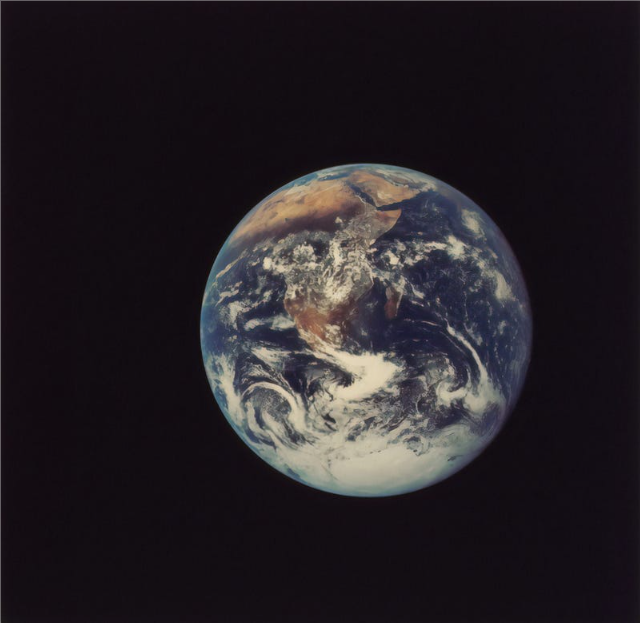
Just what is a "habitable zone", or "Goldilocks" planet? The core concept is that these planets are at the right distance from the star they orbit to have liquid water, the most fundamental requirement for carbon-based life forms.
Current thinking by the experts is tending to expand the habitable zone possibilities. Extremophile life is being discovered in many harsh ecosystem niches here, such as deep within the Earth's rocks, at the deepest points in the oceans, in acidic volcanic vents, and at the very top edges of our atmosphere. Life finds a way to exist just about everywhere.
Also, even though the moons of Saturn and Jupiter are outside the conventionally defined habitable zone, they have liquid water oceans under their ice crusts, and current speculation is that they could easily harbor life. There are likely many other planets in the known universe with similar icy ocean conditions, in addition to the planets included in conventionally defined habitable zones.
Let the calculations begin
Recently, while creating a set of free online software tools for UFO/UAP researchers, I decided to determine a way to visulaize the vast number of possible life-bearing, habitable zone planets in the known Universe. The result is a tool that uses the very latest numbers and estimates from credible scientific sources to make an estimate of the number of Goldilocks planets. The results were astounding, and hard to grasp.
I decided to create a mental visualization by equating each Goldilocks planet with a U.S. penny. By stacking these pennies a person could get a feel for the big numbers we're talking about.
For example, how much is one million? Well, a million pennies in tightly-packed-and-stacked rows and columns creates a mass roughly the size of a desk, or a small refrigerator. Keep this image in mind as we proceed with some even bigger numbers.

The program starts with default values as researched from scientific resources, but it is designed to let you experiment with different numbers. You can access the habitable_planets tool here.
We Live in a Big Universe!
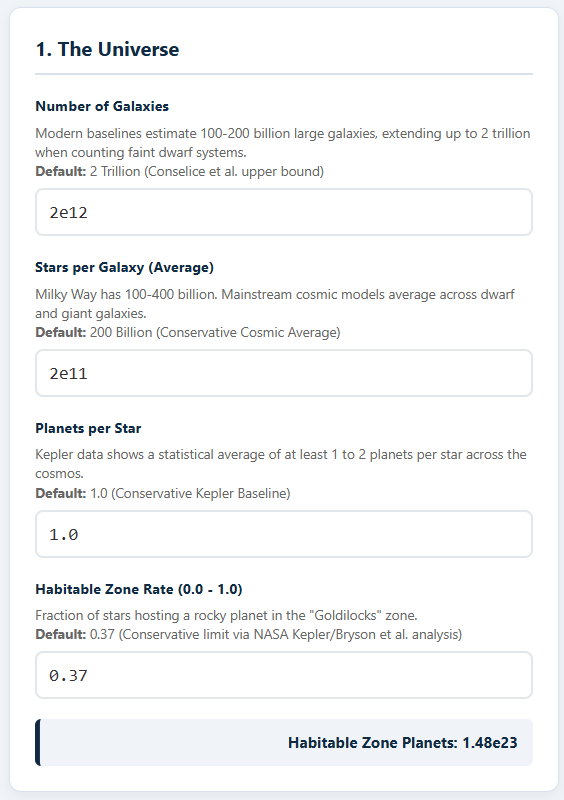
The first section of the program calculates the approximate number of habitable zone planets in the known Universe. This takes into account the number of galaxies, the average number of stars in each galaxy, and the fraction of those stars that are in the "Goldilocks Zone" - where the temperatures are not extreme. Note that this fraction could easily increase since scientists are increasingly open to data suggesting liquid oceans below icy Planets could easily sustain life.
The second section of the program defines the exact dimensions of a United States penny - its diameter and thickness in millimeters. You shouldn't change these values, unless you'd like to try a different coin of some sort. The program uses metric system values, but the results of the calculations are displayed in both miles and km.

The third section lets you define how much surface area on which you wish to stack all those pennies. We could use a football field for example, but you'll soon see that we need a much bigger area for a reasonable stack of pennies where each penny represents one predicted habitable zone planet. So big in fact that the default area in the program is the land area of the entire continental United states - from Pacifc to Atlantic, Canada to Mexico, and every square inch in between!
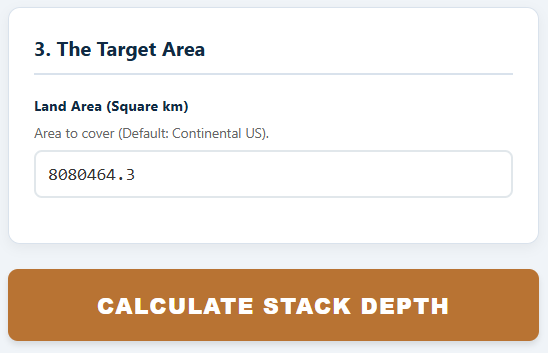
Click the "Enter any numbers you wish to change, using the same metric system units, then press the
"Calculate Stack Depth" button to calculate how high the pennies will need to be stacked to accomodate
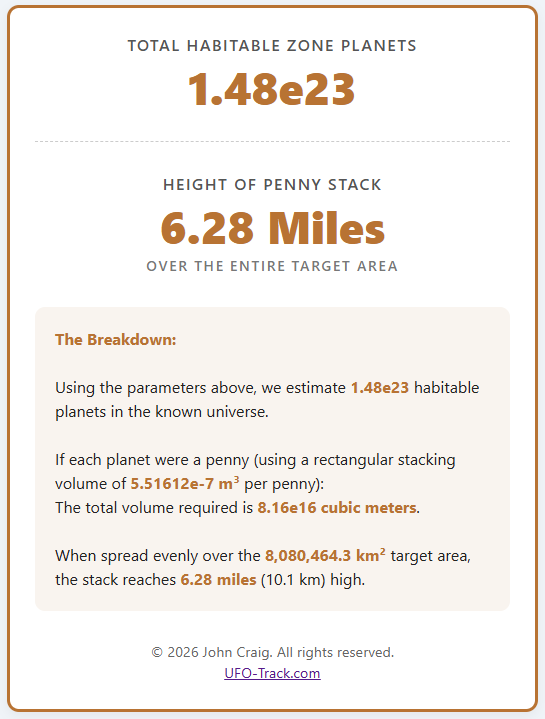
them all in the land area given. As shown here for the default scientific best-estimates, the pennies
would stack over the entire USA land area to a height higher than most commercial jets fly.
That's a lot of pennies - That's a lot of
planets!
Are we alone?
The conclusion I come back to whenever I think about this mind-boggling result is this; statistically speaking, life should have arisen many, many times in this huge Universe. If it made its way even once (it did!) then it likely did so many times over.
UFO-Track is on a mission to prove for ourselves, instead of relying on the authorities, that we're being visited by a variety of NHI (non-human intelligences), likely coming from a number of planets in our little neighborhood of this average sized galaxy. We are a network of citizens of like mind, and we'd love to have you join our network!
Join today!
Learn more about UFO-Track:
UFO-Track.com
Join the UFO-Track real-time alert network:
UFO-Track membership