UFO/UAP Elevation Angles
Why are people so inaccurate at getting this right?
NASA recently announced the team members for their Unidentified Anomalous Phenomena Study Team. What are they looking for? In my opinion, they want to divert attention from what's "behind the curtain" by seeking and studying only fresh data as we go forward. They want lots of good nuts-and-bolts data, so they can transparently apply science to the search for answers instead of relying on past events, speculation, hype and any form of pseudo-science from believers and skeptics alike.
Fresh Data Going Forward
Encouragingly, and with zero hint at any giggle-factor, they stated they want data from citizens and instruments as well as pilots and other reliable witnesses. Okay, that's fair - let's leverage this situation, give them the benefit of the doubt, and help get good data to them and to other researchers.
I covered angular size in a previous article, now it's time to tackle elevation angle, a notoriously easy-to-mess-up data point that is easy to correct with some simple understanding.
What is Elevation Angle?
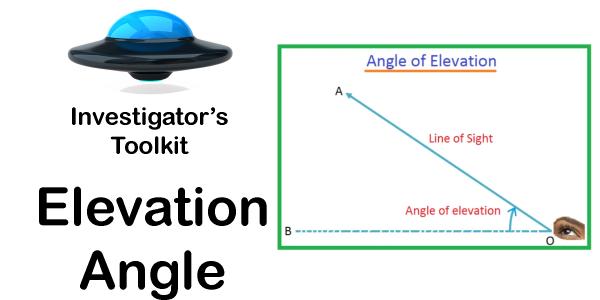
Elevation angle is the number of degrees up from the horizon to where an object is seen. Zero degrees means the object is on the horizon, 90 degrees is straight up overhead at what is called the zenith. Airplanes, satellites, balloons, the tops of trees or mountains - all these appear at some elevation angle between 0 and 90 degrees.

For UFO/UAP sightings, reporting the elevation angle accurately can help with calculating sizes, distances, and other important parameters of the unknown phenomenon. Simply put, we need to be as accurate as reasonably possible with all data we collect, in order to be as scientific as possible in extracting the truth.
People are Horrible Elevation Angle Guessers
Here's an experiment that will likely amaze you. Find the moon in the sky, day or night doesn't matter, and guess its elevation angle. There are many ways to determine the Moon's actual elevation angle on the Internet, but here's one very easy way. Go to https://www.timeanddate.com , find and click on the "Moonrise & Moonset" link. Enter or select your town, and then look for the line labeled "Moon Altitude:" to see the current elevation angle. Note that elevation angle is often referred to as altitude, although I prefer the term elevation angle.
Most people vastly overestimate elevation angle. When the Moon is at 45 degrees elevation it looks like it's way beyond half way up in the sky!
I suggest repeating this exercise several times to begin to get a more accurate feel for elevation angles.
You can also use Stellarium , with a little more effort, to get elevation angles to various stars and planets for your location, date and time. Stellarium is a great program if you're interested in the night sky at all. Give it a try!
Getting Better Data
As a Field Investigator we are trained to have the witness point at the sky to where they saw an unknown. An inclinometer of one form or another (keep reading) is then used to get a decent estimate of elevation angle. Often, witnesses will be amazed that the actual elevation angle isn't as high as they thought.
Inclinometers (Also Called Clinometers)
If you have a smartphone (who doesn't now days?) there are some decent inclinometer apps available that can help. Search the app store for "tilt", "bubble level", or "clinometer" to find something that works for reading out tilt angles in degrees. Practice using the app with the Moon so you know how to use it with reliable accuracy. Sight along the edge of your phone to the spot in the sky pointed to by the witness, then read the elevation angle.

Here's an "old school" way to make an inclinometer. Get a plastic protractor, feed a light-weight string through its center point and hang a small weight so the string hangs vertically. Sight along the base of the protractor and determine the angle indicated by the hanging string.

If you have the funds, you can buy an inclinometer from Amazon or elsewhere. Here are a few analog and digital models to consider.
Yet Another Smartphone App
Some camera apps provide good elevation angle data. In particular, I'm very fond of GeoCam Pro, as it optionally superimposes a variety of great data onto photographs it snaps, similar to the futuristic binoculars from the early Star Wars scenes. Here's a neighborhood tree top located at about 24 degrees elevation angle from my camera.

My phone is an Android. If you have an iPhone, check around for a similar type of camera app.
A Handy Way to Estimate Elevation Angles
To get beyond just wild guessing, it's easy to get a fairly decent estimate of elevation angle using just your own hand at arms length. Your pinky finger's width is approximately 1 degree, three fingers is about 5 degrees, your fist is about 10 degrees, and so on.

Take a look at this handy illustration (pun intended) and memorize the illustrated angle techniques. Go to LoveTheNightSky.com for a great explanation of how to make these measurements (along with a lot of other good information.)
I suggest practicing by spanning from horizon to zenith, repeating the various gestures to make sure they work out to a total of 90 degrees. A little practice can improve your accuracy significantly.
Python to the Rescue
I'm passionate about hacking the world's challenges with Python, so here we go again! A nice right triangle is formed by the vertical line from an object to the ground, the distance along the ground from that spot to the observer, the straight line distance from the observer to the object, and of course the elevation angle up to the object. If we know any two of these measurements, we can calculate all the others.

For practice, find a tower, building, flagpole, rooftop, tree, or other object where you can determine any combination of two of these measurements. The following program then lets you calculate the other two. (Be sure to adjust appropriately for eyeball height above the ground.)
# elev_angle.py

from math import sin, cos, tan, atan, radians, degrees

print("\nEnter two known values\n")

a = input("Height: ")
a = float(a) if a else 0

b = input("Horizontal distance: ")
b = float(b) if b else 0

c = input("Straight line distance: ")
c = float(c) if c else 0

elev = input("Elevation angle: ")
elev = radians(float(elev)) if elev else 0

if not elev:
    if a and b:
        c = (a * a + b * b) ** 0.5
    elif a and c:
        b = (c * c - a * a) ** 0.5
    else:
        a = (c * c - b * b) ** 0.5
    elev = atan(a / b)
else:
    if a:
        b = a / tan(elev)
    elif b:
        a = b * tan(elev)
    else:
        a = c * sin(elev)
        b = c * cos(elev)
elev = degrees(elev)

print("\nHeight: ", a)
print("Horizontal distance: ", b)
print("Straight ine distance: ", c)
print("Elevation angle: ", elev)


# Enter two known values
#
# Height:
# Horizontal distance: 27
# Straight line distance:
# Elevation angle: 42
#
# Height:  24.310909196041678
# Horizontal distance:  27.0
# Straight line distance:  36.332083699372156
# Elevation angle:  42.0
For example, say you use an inclinometer to measure the angle to the top of a tree as 42 degrees, and you use a
tape measure to determine you are 27 feet from the tree. Run the program, just pressing
Enter
for the two unknown values, and you should get the results as shown in the comment lines at the end of the
listing.
Grokking Elevation Angles
By using this program in a variety of scenarios, you should gain a good instinctual understanding of elevation angles. By practicing the hand gesture measurements you should gain the ability to quickly estimate elevation angles with significant accuracy. And by using an Inclinometer in one form or the other you should be able to measure elevation angles with increasing precision. The data you provide for a UFO/UAP sighting, yours or someone else, just might help NASA or other researchers gain a better understanding of this phenomenon.
Proactive Disclosure
With enough good solid nuts-and-bolts evidence, perhaps we can tug at the curtain to force a peek at what's already known from past facts and solid evidence. But that's a whole can of worms for future discussions. Stay tuned!
Thank you for reading - if the subject of UFOs and Citizen-led Disclosure truly fascinates you - here are some more ways you can connect with other like-minded beings.
report.UFO-Track.com

patreon.com/ufotrack

If you like to know more about how to receive the UFO alerts for objects flying around your location, join our patreon: patreon.com/ufotrack
youtube.com/@ufo-track

UFO-Track's YouTube Channel - please subscribe
merch.UFO-Track.com

books.UFO-Track.com

UFO-Track.com
