Tools.UFO-Track.com: UFOs and Angular Size
"It was the size of a basketball at arm's length." ... Seriously????
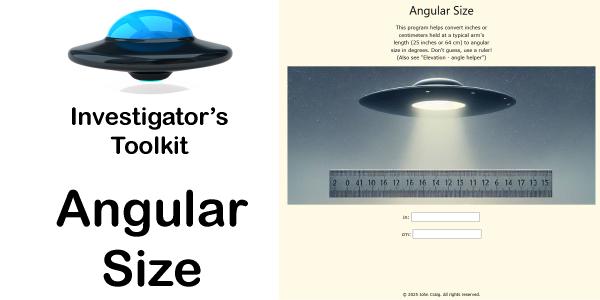
What is Angular Size?
Angular size is the apparent visual size of an object, and it depends both on the actual size and the actual distance of an object from the viewer.
For example, the sun and the moon have nearly identical angular sizes, even though the sun has a diameter 400 times bigger than the moon. The sun is about 400 times as far away from the earth as the moon is, so it all works out.
Most people are extremely inaccurate when trying to estimate angular size, especially when they are describing strange and elusive objects like nothing they've ever seen before. Yes, I'm talking about UFOs, or UAPs as some want us to call them.
A short Python program, and careful questioning of a witness, can help make this important metric somewhat more accurate.
Angular Size at Arm's Length
A very standard way to express angular size is to hold a ruler at arm's length and describe how many inches visually cover the diameter of an object. Measured this way, the sun or the moon cover about 1/4 inch at an average "arm's length" of 25 inches.

Now here's the weird part. Most people vastly overestimate the number of inches, or the angular size, of an object in the sky unless they actually hold up a smaller object, or preferably a ruler, and take a careful look.
Ask someone to guess an object they think will just cover the moon's disk when held at arm's length, and they'll likely name something way too big. Oranges, tennis balls and even golf balls are way, way too big. Even a U.S. penny is 3 times the diameter of the moon when held at arm's length!
Calculating the Real Size of Objects
To determine an object's real size, you need both its distance from an observer and its angular size. Distance is often easier to estimate (not always!) and with some coaching and holding up a ruler the estimated angular size can be pinned down more accurately. Plugging these numbers into the following Python program can help determine a more educated estimate of an object's true size.
To simplify the calculations, the observed ruler inches is input, along with the estimated distance of the object in feet, and both the angular size and estimated actual size are output.
from math import *
arms_length = 25 # inches
def round_significant(x, n):
    return round(x, -int(floor(log10(x))) + (n - 1))
def angular_size(in_at_arms_len):
    angle = degrees(atan2(in_at_arms_len, arms_length))
    return round_significant(angle, 2)
def diameter(in_at_arms_len, ft_distance):
    diameter = in_at_arms_len * ft_distance / arms_length
    return round_significant(diameter, 2)
if __name__ == "__main__":
    i = eval(input("\nInches at arm's length? "))
    f = eval(input("Approximate distance in feet? "))
    angle = angular_size(i)
    size = diameter(i, f)
    print(f"\nAngular size in degrees: {angle}")
    print(f"Approximate size in feet: {size}")
Some Cool Python Explanation
Python provides the round() function to round off number to so many digits after the decimal point. The round_significant() function above rounds numbers to so many significant digits, without regard to the location of the decimal point. It's pretty handy.
The angular_size() and diameter() functions use the observed size on a ruler held at arm's length plus the estimated distance to an object to calculate the angular size in degrees and the estimated actual size of an object.
I've used the eval() function to process the strings that are input by the user. This allows calculations directly in the input. For example, if the observed size on the ruler is a quarter inch, you can type "1/4". Likewise, at half a mile estimated distance you can enter "5280/2" for the desired number of feet. That's another handy item for your Python bag of tricks!
Getting Back to the Basketball Claim
The average basketball is 9.5 inches in diameter, so let's try out the program to see how big a UFO would be if it were really the size of a basketball at arm's length and about a football field away, or 300 feet.
The program reports an angular size of 21 degrees, and a real-world diameter of 110 feet. That's really big! A UFO could actually be that big, but the witness should carefully think it through and use that ruler at arm's length to double check their estimate of angular size.

Subscribe up to join the Real-Time UFO Alert Service at Patreon.com/ufotrack - This is a system we are developing to alert people in the network to UFO / UAP activity in their area - in real time - to increase witnesses and credibility to UFO sightings everywhere!
Follow all of John's UFO endeavors at UFO-Track.com , subscribe to the UFO-Track YouTube channel here for VERY interesting videos about UFO Investigations , report a UFO here .
